
+91 9008 41 9008
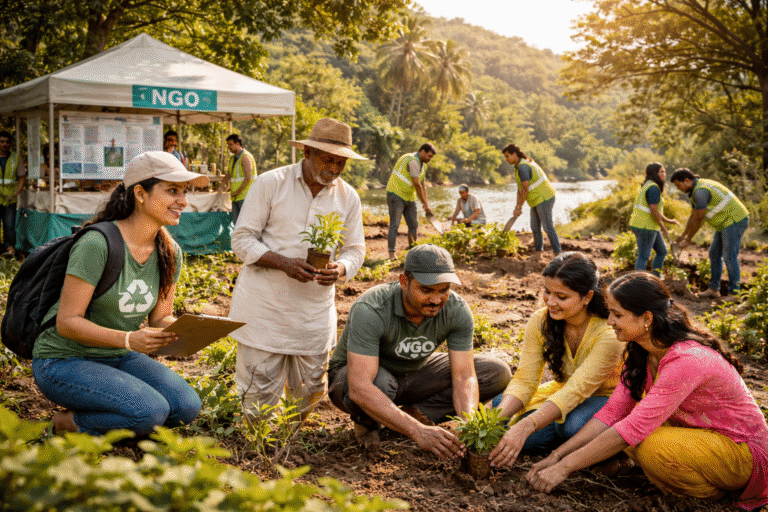
Climate change is no longer a distant threat; it is a reality reshaping our world today. Melting glaciers, rising sea levels, extreme weather events, and vanishing forests are no longer isolated incidents but daily headlines. The planet is sending us a clear message: time is running out. While governments and industries play crucial roles in addressing this crisis, non-governmental organizations (NGOs) have emerged as powerful catalysts for change. They bring communities together, influence policies, and drive grassroots action, turning awareness into impact.
Among such changemakers, Flybird Foundation stands committed to environmental preservation, social awareness, and sustainable living. Through its initiatives, the Foundation is demonstrating how NGOs can lead the way in fighting climate change from the ground up.
Climate change refers to long-term alterations in temperature, rainfall, and weather patterns, primarily caused by human activities such as burning fossil fuels, deforestation, and industrial pollution. These actions release greenhouse gases that trap heat in the atmosphere, leading to global warming.
The consequences are already evident: intense droughts, unpredictable rainfall, floods, loss of biodiversity, and health challenges due to rising temperatures. Coastal regions face the constant threat of submersion, while farmers struggle with erratic monsoons that affect their livelihoods.
But amidst these challenges lies an opportunity, the opportunity to act, to adapt, and to restore balance. NGOs like Flybird Foundation are working tirelessly to turn awareness into action, empowering individuals and communities to fight this global crisis with local solutions.
NGOs play a unique role in bridging the gap between people and policy. They operate at the grassroots level, where change begins, educating, mobilizing, and implementing solutions that directly impact communities. Unlike large bureaucratic systems, NGOs are agile, responsive, and deeply connected to local needs.
Here’s why their role is indispensable:
Community Engagement: NGOs bring people together, helping them understand the local effects of climate change and empowering them to take ownership of environmental initiatives.
Awareness and Education: Through campaigns, workshops, and school programs, they help communities understand how simple lifestyle changes can make a big difference.
Policy Advocacy: NGOs influence government and corporate policies to encourage sustainable practices and promote renewable energy solutions.
Restoration Efforts: From tree plantations to waste management, NGOs implement on-ground projects that contribute directly to ecological balance.
Innovation and Research: Many NGOs experiment with sustainable farming, green technologies, and conservation models that can be scaled for broader impact.
In short, NGOs act as both educators and enablers, driving environmental action through knowledge, collaboration, and compassion.
The Flybird Foundation believes that true change begins when people understand their responsibility towards nature. Its climate action programs are designed to inspire conscious living and promote sustainability through small, consistent efforts that collectively create large-scale impact.
Some of the Foundation’s ongoing and planned initiatives include:
Tree Plantation Drives: Restoring green cover in urban and rural areas to combat rising temperatures and air pollution.
Water Conservation Campaigns: Encouraging communities to save, reuse, and manage water efficiently to withstand droughts and climate shifts.
Waste Management Programs: Promoting segregation, recycling, and responsible disposal of household and industrial waste.
Awareness Sessions in Schools: Educating young minds about climate change, energy conservation, and sustainable habits.
Community Clean-Up Drives: Mobilizing citizens to maintain clean surroundings and reduce plastic pollution.
These initiatives represent more than just environmental projects; they are movements of hope, unity, and responsibility.
One of the most impactful ways NGOs fight climate change is by empowering communities to implement localized solutions. Every region faces different climate challenges, and local participation ensures that solutions are practical and sustainable.
For instance, in drought-prone areas, NGOs may focus on rainwater harvesting and watershed management. In urban settings, the emphasis may shift to reducing carbon footprints through waste reduction and green mobility.
Flybird Foundation’s approach follows this same principle: think globally, act locally. By involving volunteers, schools, and rural families in its programs, it ensures that environmental action becomes a shared community effort rather than a top-down mandate.
Change begins with awareness, and awareness begins with education. The Flybird Foundation believes that nurturing an environmentally conscious generation is one of the most powerful tools in combating climate change.
Through school programs, storytelling campaigns, and interactive activities, the Foundation teaches students how everyday choices from switching off lights to reducing plastic use, contribute to a healthier planet.
When children carry these lessons home, they inspire their families and neighborhoods. Over time, this ripple effect builds a culture of sustainability where people act out of awareness, not obligation.
Climate change is a global problem that demands collective solutions. NGOs often collaborate with local governments, environmental organizations, and businesses to strengthen their efforts.
Flybird Foundation actively seeks partnerships that can amplify its initiatives, be it through tree plantation drives, renewable energy projects, or awareness workshops. These collaborations create a multiplier effect, expanding reach and ensuring that more people become part of the solution.
Together, such alliances prove that fighting climate change is not the responsibility of one organization alone but a shared mission for all.
One of the most practical contributions NGOs make is promoting sustainable lifestyles, showing people how small daily choices can reduce carbon emissions.
Flybird Foundation encourages:
Using eco-friendly products instead of plastic.
Supporting local and organic farming.
Conserving electricity and water.
Planting trees around homes and workplaces.
Opting for public transport or cycling when possible.
These are not monumental acts but meaningful habits that, when adopted collectively, can drastically reduce environmental stress.
Sustainability starts with awareness, but thrives on consistency, and that’s the philosophy behind the Foundation’s initiatives.
At the heart of every NGO’s success lies its volunteers, individuals who give their time, energy, and passion for a cause greater than themselves. Flybird Foundation’s environmental projects have seen the enthusiastic participation of students, professionals, and community members who believe that small actions can spark big transformations.
Volunteers plant trees, organize awareness campaigns, participate in clean-up drives, and become ambassadors for environmental protection in their circles. This people-driven movement is proof that change begins with a single step, and when thousands take it together, it becomes unstoppable.
While NGOs are making incredible strides, their journey is not without challenges. Limited funding, lack of resources, policy barriers, and low public awareness often hinder their progress.
However, organizations like Flybird Foundation continue to persevere through collaboration, community engagement, and a strong sense of purpose. Their success lies in their ability to turn obstacles into opportunities by inspiring people to take collective ownership of the planet’s future.
Climate change is not a problem that can be solved by governments or scientists alone. It requires the involvement of every citizen, every organization, and every community. NGOs like Flybird Foundation are leading this fight by turning awareness into action, and concern into commitment.
Their grassroots efforts prove that even in the face of global challenges, local action can make a world of difference. When people unite for a cause, the power of change multiplies.
The future of our planet depends on what we do today, and together, we can ensure it remains green, vibrant, and full of life for generations to come.

Together, we spread hope, inspire change, and shape brighter futures.
Flybird Foundation © All Rights Reserved.