
+91 9008 41 9008
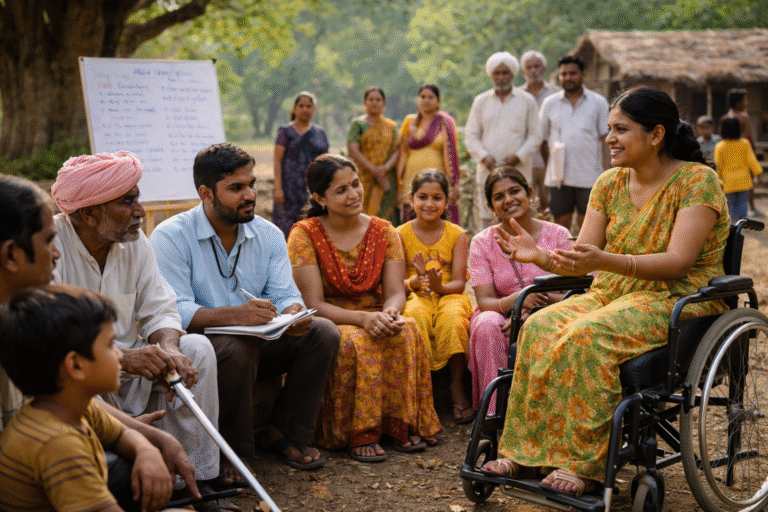
In today’s rapidly evolving world, the term “development” carries immense significance. Yet, true progress cannot be defined merely by technological advancement, economic growth, or infrastructural expansion. The real measure of development lies in its inclusivity, ensuring that every individual, regardless of gender, caste, class, ability, or background, has equal access to opportunities, resources, and participation. Inclusive development is not just a social goal; it’s the foundation of a balanced, just, and sustainable society.
At its core, inclusive development seeks to remove barriers that prevent individuals and communities from fully contributing to and benefiting from progress. It recognizes diversity as a strength and promotes equality as the path to collective growth. Modern society, now more interconnected than ever, demands inclusivity in every sphere: education, employment, healthcare, governance, and community life.
Inclusive development goes beyond the traditional idea of growth. It ensures that progress reaches every corner of society — including marginalized communities that often remain excluded from mainstream benefits. It focuses on participation, equity, and empowerment, aiming to bring together social justice and economic opportunity.
This form of development does not treat people as passive recipients of aid but as active participants in shaping their destinies. It respects cultural differences, acknowledges systemic barriers, and works towards building societies that are fair, compassionate, and balanced.
A society that excludes certain groups can never truly flourish. When people are left behind due to economic status, physical ability, gender, or social discrimination, the very foundation of growth becomes weak. Inclusivity ensures that everyone’s potential is utilized leading to more innovation, productivity, and harmony.
Moreover, inclusive development helps in:
Reducing inequality: By giving equal access to education, healthcare, and employment, disparities can be minimized.
Encouraging participation: People feel valued when their voices are heard and respected in policy and decision-making.
Building stronger communities: Inclusion fosters unity and mutual understanding, reducing social conflicts.
Ensuring sustainable growth: Development that benefits all sections of society is more stable and lasting.
When every citizen contributes to and benefits from progress, society becomes resilient and self-sustaining.
Inclusive development stands on several interconnected pillars. Each of these ensures that progress is both equitable and enduring.
A. Equal Access to Education
Education is the foundation of empowerment. Ensuring that children from all backgrounds, including rural, economically weaker, or differently-abled groups, receive quality education creates a pathway to opportunity. Education helps bridge social divides and nurtures informed, confident individuals who can contribute to nation-building.
B. Economic Opportunities for All
Job creation, fair wages, and skill development are crucial. When the economy supports small-scale entrepreneurs, women-led businesses, and local artisans, it nurtures inclusive growth. Governments and organizations must focus on empowering individuals to earn a livelihood with dignity.
C. Gender Equality
Empowering women and promoting gender balance is one of the strongest indicators of inclusivity. Equal participation in leadership, workplace, and decision-making ensures that society benefits from diverse perspectives and talents.
D. Accessible Healthcare
Health is a fundamental right. Inclusive development means that no one is deprived of healthcare due to poverty or location. Strengthening healthcare infrastructure in rural and marginalized regions is vital for holistic development.
E. Infrastructure and Accessibility
Modern development must also be physically inclusive through accessible public spaces, transport systems, digital inclusion, and facilities for people with disabilities. True progress happens when infrastructure serves everyone, not a privileged few.
F. Environmental Sustainability
Inclusion is not limited to people alone; it also extends to the planet. Sustainable practices ensure that natural resources are preserved for future generations. Green initiatives, renewable energy, and waste management are all parts of inclusive progress.
Inclusive development does not just serve moral or ethical goals, it has tangible social and economic benefits. When more people are empowered to contribute, the overall economy strengthens. Innovation thrives in environments where diversity of thought exists.
Socially, inclusion promotes peace and stability. When people feel seen and respected, social cohesion improves, and conflicts reduce. Economically, inclusion increases the labor force participation rate and improves productivity. This leads to a stronger GDP and sustainable growth.
Thus, inclusion is both a moral necessity and a smart economic strategy.
Despite global awareness, several barriers still prevent true inclusivity:
Economic disparity: Unequal wealth distribution keeps many communities trapped in poverty.
Lack of awareness: Social stigma, stereotypes, and ignorance about inclusion hinder progress.
Policy gaps: Even well-intentioned policies often fail to reach the most vulnerable groups.
Digital divide: In the modern era, access to technology determines access to opportunity. Many rural and low-income communities remain digitally excluded.
Gender bias and discrimination: Deep-rooted social norms often marginalize women and minorities.
These challenges remind us that inclusive development requires not just intent but continuous action and reform.
Institutions, NGOs, and corporate entities play a crucial role in promoting inclusion. By implementing Corporate Social Responsibility initiatives, companies can bridge gaps in education, healthcare, and skill development.
Organizations like Flybird Foundation are instrumental in driving community-level change. Through initiatives such as education support for underprivileged children, women empowerment programs, and health awareness drives, they help create opportunities for those often left behind.
Such initiatives not only uplift individuals but also strengthen the fabric of society, ensuring that progress is shared and sustained.
Technology has immense potential to make development more inclusive. From digital education to telemedicine and online entrepreneurship, technology breaks barriers of geography and class.
Digital platforms enable small businesses to reach global markets, give rural communities access to information, and connect individuals to essential services. However, bridging the digital divide is essential to ensure everyone benefits equally from these advancements.
At the heart of inclusive development lies empathy, the ability to understand and value others’ experiences. Creating an inclusive society starts with changing mindsets. Schools, workplaces, and communities must encourage empathy, respect, and open dialogue.
When inclusion becomes part of everyday values, discrimination and bias naturally decline. This cultural transformation is as important as policy changes, ensuring that inclusivity becomes ingrained in the very identity of society.
Modern societies must evolve with inclusivity at their core. Governments need to design people-centric policies, businesses must embrace social responsibility, and individuals should practice compassion and equality in daily life.
The journey towards inclusive development is ongoing. It requires continuous evaluation, collaboration, and awareness. By creating systems that prioritize equity, we can ensure that no one is left behind in the race for progress.
Inclusive development is not just a policy objective; it’s a shared moral responsibility. True progress happens when every individual has a fair chance to live with dignity, pursue their dreams, and contribute to society’s growth.
As the world moves forward, embracing inclusivity is no longer optional; it is essential. A truly developed society is one where growth is shared, justice prevails, and humanity stands united in compassion and equality. Through collective effort and awareness, we can build a world where progress belongs to everyone.

Together, we spread hope, inspire change, and shape brighter futures.
Flybird Foundation © All Rights Reserved.