
+91 9008 41 9008
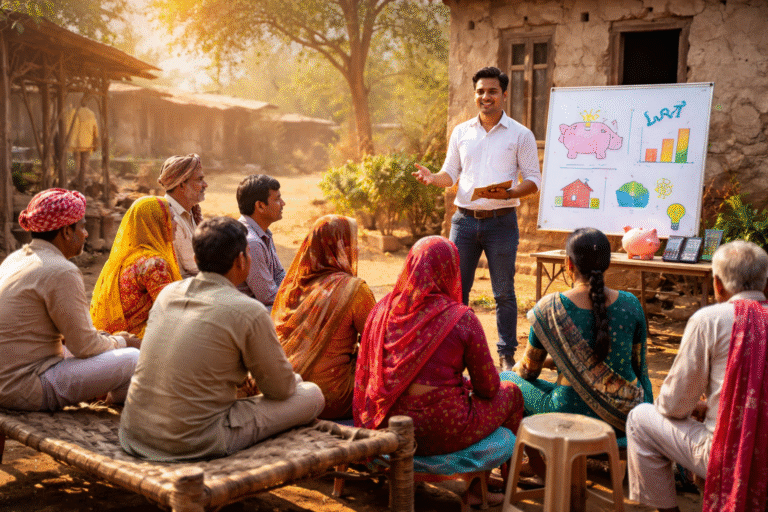
In rural India, dreams have always been abundant: farmers dreaming of better harvests, women dreaming of financial freedom, and young people dreaming of brighter futures. But dreams need knowledge, and knowledge needs access. For decades, villagers managed money instinctively rather than strategically. Savings were stored in small tins or hidden in grains. Borrowing often happened through informal sources with heavy interest. Investments were rare because they seemed complicated or distant.
But the landscape is changing. Across India, a quiet transformation is taking place, one where financial literacy is becoming the bridge between hardship and hope. Through awareness programs, workshops, and community-driven learning, villagers are discovering the power of budgeting, saving, banking, insurance, and entrepreneurship. And in this journey, organizations like Flybird Foundation are emerging as catalysts of change, helping rural communities not only manage money, but build dreams.
In urban settings, financial literacy often sounds like a technical term. But in villages, it has a deeper meaning it is the difference between vulnerability and empowerment. It means knowing how to:
Protect one’s income
Save wisely
Borrow responsibly
Invest with confidence
Secure the family’s future
When financial knowledge enters a home, it changes everything. People begin to make informed decisions. They stop depending blindly on middlemen. They negotiate better. They plan better. They dream bigger.
Financial literacy is not just education it is liberation.
The financial world is modernizing faster than rural communities can keep up. Digital transactions, UPI payments, microfinance options, government schemes, and insurance plans are all powerful tools, but only for those who understand them.
Villagers face unique challenges:
Limited banking access
Misinformation or fear of formal finance
Dependence on informal lenders
Sudden income fluctuations
Very little exposure to savings habits
Financial literacy addresses these issues at the root. It simplifies complex ideas and brings clarity to everyday decisions:
How to open a bank account
How to use UPI safely
How to avoid fraud
How to plan monthly expenses
How to use government welfare schemes
Empowerment begins when people understand how money works, not just how to earn it.
Savings have always existed in rural India, but often in risky or informal ways. Financial literacy transforms this instinct into method.
Trainers teach villagers:
How to create a small monthly budget
Why emergency funds matter
How even ₹10 a day can become meaningful savings
How banks and self-help groups can protect and grow their money
Once villagers see real examples of how small, consistent savings can lead to major benefits education, healthcare, home repairs, and business investments, they begin embracing long-term financial discipline.
A village that learns to save becomes a village ready to rise.
In many villages, informal lenders still hold immense power. High interest rates trap families in debt, sometimes for generations. Financial literacy helps break this cycle.
Sessions focus on:
Recognizing exploitative lending
Understanding affordable credit options
Learning about microfinance institutions
Building credit history through banks
Choosing loans wisely for real growth, not short-term relief
When villagers learn the difference between good debt and bad debt, they begin using credit as a tool — not a trap.
Debt no longer becomes destiny.
Technology is rewriting the rules of finance. Even in rural areas, smartphones are becoming gateways to opportunity.
Financial literacy programs now include digital training:
How to use UPI safely
How to check bank balances online
How to access government schemes digitally
How to avoid online fraud and scams
How to keep PINs and passwords secure
With confidence in digital payments, villagers gain independence. They stop relying on others to access their own money. They save time, reduce risk, and gain financial autonomy.
A smartphone becomes not just a device, but a financial companion.
In rural India, women are the quiet architects of stability. They manage households, protect savings, and nurture futures. But many have historically lacked access to financial education.
When women become financially literate:
Households become more secure
Children’s education improves
Healthcare decisions become stronger
Savings become more structured
Micro-entrepreneurship flourishes
Self-help groups, micro-savings initiatives, and women-led cooperatives are turning rural women into confident financial leaders. Financial literacy is giving them not just knowledge, but a voice.
Entrepreneurship in villages is no longer limited to agriculture. With guidance, villagers are starting:
Small retail shops
Dairy businesses
Tailoring units
Handicraft ventures
Mobile repair centers
Local transport services
Financial literacy teaches them:
How to calculate profit and loss
How to reinvest earnings
How to price products
How to manage business expenses
How to apply for small business loans
The shift is powerful; villagers are transitioning from wage-dependent workers to confident business owners. Entrepreneurship is becoming the new engine of rural progress.
Villagers learn best through shared experiences. Group workshops, peer discussions, and real-life demonstrations create stronger, long-lasting impact.
Community-led financial education helps:
Build trust
Inspire collective discipline
Encourage accountability
Strengthen social bonds
Create role models within the community
When one family learns to manage money better, it inspires the entire village. Financial literacy becomes a shared culture, not an individual skill.
The next generation of rural India is more aware, more connected, and more ambitious than ever. But ambition needs direction.
Financial literacy helps young villagers learn:
How to plan careers
How to save early
How to avoid risky spending
How to start small businesses
How to use digital tools confidently
When rural youth understand finance, they become future-ready decision makers who uplift their families and communities.
For many villagers, banks used to feel intimidating. But financial literacy programs have helped dissolve fear and build trust.
Villagers now understand:
The safety of deposits
The benefits of fixed and recurring deposits
The purpose of bank statements
Why documentation matters
How ATM and digital systems work
Trust changes behaviour and behaviour changes destiny.
Rural India has access to numerous welfare schemes, but lack of awareness often keeps benefits out of reach.
Through financial literacy sessions, villagers learn about:
PM Jan Dhan Yojana
PM Kisan
PM Jeevan Jyoti Bima
Atal Pension Yojana
Mudra Loans
SHG-linked financing
When people understand eligibility and application processes, they begin claiming what they rightfully deserve. Government support reaches the doorstep — not just the paperwork.
Flybird Foundation believes financial literacy is a fundamental right, not a privilege. The foundation organizes awareness programs, village workshops, women-led financial circles, youth training, and digital literacy drives that help rural communities enhance their financial well-being.
The goal is simple yet transformative to build villages where every family understands money, uses it wisely, and grows with dignity. Through grassroots engagement and empathetic teaching, Flybird Foundation helps villagers not just manage money but also believe in their potential.
Financial literacy is not just about today, it is about securing tomorrow. Villagers are taught how to plan long-term goals, such as:
Children’s education
Home construction
Healthcare needs
Business expansions
Retirement security
When families begin to plan ahead, financial stress reduces, confidence rises, and dreams become achievable. Planning lights up a path where there was once uncertainty.
The most profound change is cultural.
Families start recording their expenses.
Women maintain savings books.
Youth help elders with digital banking.
Small businesses keep journals.
Villages begin talking about money openly without guilt or fear.
Financial responsibility becomes a shared value, strengthening the entire rural ecosystem.
Financial literacy is more than a skill; it is a lifeline. It transforms rural communities by giving them control over their money, their dreams, and their future. From budgeting and saving to entrepreneurship and digital empowerment, financial awareness opens doors that once seemed permanently closed.
Through initiatives like those of Flybird Foundation, villagers gain the tools to turn uncertainty into stability and aspirations into achievements. When knowledge enters a village, prosperity follows closely behind. And with empowerment spreading from one household to another, rural India is stepping into a future defined not by limitations but by possibilities, confidence, and hope.

Together, we spread hope, inspire change, and shape brighter futures.
Flybird Foundation © All Rights Reserved.