
+91 9008 41 9008
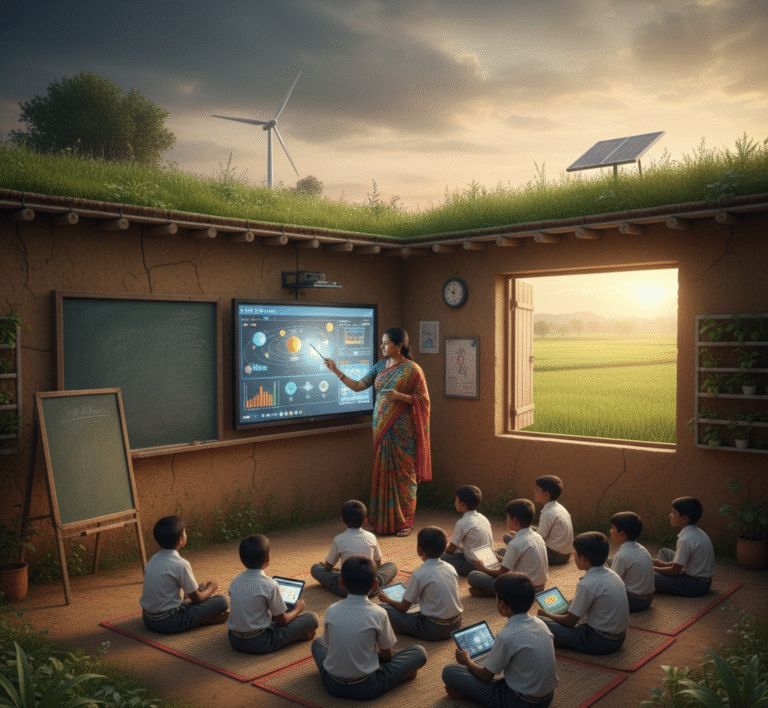
For decades, the sound of chalk against a blackboard echoed through rural classrooms across India. Simple, familiar, and often the only tool available, the chalkboard stood as a symbol of education in villages. But as the world outside transformed with screens, digital platforms, and modern learning tools, rural India too began to witness a quiet yet profound shift.
A shift from the traditional chalkboard to the dynamic possibilities of smart boards.
A shift from rote learning to interactive understanding.
A shift from limited exposure to limitless opportunities.
What started as a small wave of digital inclusion has now grown into a movement reshaping how children in rural India learn, dream, and imagine their futures.
This is not just a story about technology.
It is a story about hope meeting opportunity.
A story of classrooms evolving and communities progressing.
A story of how digital education is bridging the gap between rural aspirations and global possibilities.
For generations, rural classrooms ran on dedication more than resources. Teachers taught with limited tools but abundant passion. Children learned with sincerity, often sitting in old benches under dim lights, surrounded by minimal teaching aids.
Yet several challenges persisted:
Outdated textbooks and limited access to fresh content
Overcrowded classrooms
Minimal visual learning tools
No exposure to digital concepts
Language barriers leading to rote memorization
Lack of teacher training in modern methods
Limited subject variety, especially in science and technology
Poor access to reference materials and libraries
Despite these limitations, the thirst to learn never stopped. What lacked was opportunity, not willingness.
And technology became the bridge.
When digital learning tools first entered rural India, they brought more than just gadgets; they brought curiosity.
Children who had never touched a tablet suddenly saw videos explaining planets, water cycles, human anatomy, and languages. Teachers who once relied only on textbooks gained new ways to explain concepts.
Smart boards, projectors, educational videos, and digital classrooms turned learning into exploration.
This shift created a spark, a belief that education could be modern, creative, and deeply engaging.
The chalkboard hadn’t disappeared.
But it finally found a partner in shaping a more powerful learning experience.
Technology didn’t just change how lessons were taught; it changed how children understood the world.
Here’s how digital tools brought transformation:
Concepts once memorized are now seen, heard, and experienced.
Animated videos
3D diagrams
Interactive quizzes
Real-life application examples
Children began to understand why, instead of only what.
Village children now access the same information as students in cities:
Digital libraries
Online modules
Recorded lectures
Interactive learning apps
For the first time, rural education became a window to the world, not just the immediate surroundings.
Smart boards turned dull lessons into interactive sessions.
Children started participating, questioning, and exploring skills crucial for future growth.
Teachers received the support they had long needed:
Better teaching resources
Training in digital tools
Access to upgraded lesson plans
More time to focus on individual student needs
Technology made teaching more effective and fulfilling.
Digital access means rural children are no longer left behind.
They can now:
Learn coding
Attend online workshops
Prepare for competitive exams
Explore career paths beyond their village
Technology is redefining their aspirations.
When a child from a village sees a rocket launch on a smart board, something shifts.
When they watch a doctor explain the human heart through animation, their imagination opens.
When they learn English with audio assistance, confidence grows.
When they see videos of global classrooms, ambition expands.
This emotional uplift is the greatest impact of technology.
Children begin to dream bigger.
Parents begin to believe more.
Teachers feel more empowered.
Communities begin to evolve.
Education becomes not just a routine, but an inspiration.
Flybird Foundation understands that digital literacy is no longer optional—it is essential.
The foundation’s vision is to ensure that rural children receive the same opportunities to learn, explore, and grow as any urban student.
The foundation supports schools with:
Basic digital equipment
Projectors
Smart learning tools
Supplementary digital materials
Audio-visual learning aids
Empowering teachers means empowering generations.
The foundation conducts training on:
Using smart boards effectively
Managing digital lesson plans
Interactive teaching techniques
Navigating education apps and resources
Children learn:
Basic computer skills
Mobile literacy
Online safety
Internet research skills
Typing and digital communication
These skills are essential for future academic and career opportunities.
Many rural parents hesitate with digital tools due to unfamiliarity.
Flybird Foundation builds awareness about:
The benefits of technology
Digital safety for children
Importance of modern education
Encouraging home learning
The foundation believes that technology should empower—not overwhelm.
Their initiatives ensure that digital tools become seamlessly integrated into everyday learning.
Despite the progress, several challenges remain:
Limited electricity
Unstable internet
High cost of devices
Lack of student-owned digital equipment
Need for consistent teacher training
Language and content accessibility issues
Fear of technology among older community members
But with awareness, support programs, and community involvement, these barriers are gradually lowering.
Every small step creates space for bigger change.
One of the most beautiful outcomes of digital education is its impact on young girls.
In many rural communities, girls face:
Early marriage pressure
Lower priority for education
Household responsibilities
Limited career exposure
Smart boards and digital learning change this.
Girls now learn:
Science and technology concepts
Digital skills
Financial literacy
Health and hygiene awareness
Career options beyond traditional expectations
Technology provides confidence, visibility, and new possibilities.
It gives every girl a fair chance to dream—and pursue those dreams.
Digital classrooms prepare children for careers that require:
Problem-solving
Critical thinking
Collaboration
Digital communication
Creativity and innovation
Students exposed to technology early are more likely to:
Pursue higher education
Qualify for newly emerging jobs
Compete in modern industries
Think beyond geographical limitations
Technology is building a future generation that is ready for the global world.
The impact of digital learning goes far beyond classrooms.
Communities benefit through:
Increased awareness
Improved digital participation
Higher financial literacy
Enhanced access to government schemes
Better communication tools
More interest in entrepreneurship
Digitally aware children inspire digitally aware families—and digitally progressive villages.
For decades, rural children were held back by a lack of exposure. Textbooks were outdated, examples were urban-centric, and many concepts never came to life in the classroom. With digital learning tools entering rural schools, that barrier is finally breaking.
Today’s students can explore oceans through 3D videos, understand science through animated diagrams, and listen to stories narrated in their own regional languages. This shift is not just about access to technology; it is about giving rural children a fair chance to dream, learn, and compete.
Teachers are reporting that students who once struggled to grasp abstract concepts now raise their hands with confidence. Digital inclusion is becoming the bridge that connects rural classrooms with a world of possibilities previously out of reach.
Technology in rural education is not just uplifting students; it is reinventing the role of teachers. In many villages, teachers often felt unsupported due to limited resources and outdated training modules. But with digital toolkits, interactive software, and virtual teacher-training platforms, their teaching capacity has expanded dramatically.
Workshops organized by foundations and NGOs have helped teachers learn how to use smart boards, digital libraries, and interactive lesson plans. This empowerment gives them renewed motivation and confidence.
Most importantly, teachers now feel they are part of a modern education ecosystem rather than being left behind. They are changing from traditional chalk-and-talk instructors into dynamic facilitators of learning, making classrooms more engaging and student-focused.
Introducing technology in rural schools is just the first step; sustaining it requires community involvement. Over time, rural parents and village committees have begun playing a more active role in protecting and promoting digital learning setups.
In several villages, parents’ groups have voluntarily taken responsibility for maintaining equipment, ensuring classrooms stay clean, and monitoring usage so the tools benefit every child. Youth volunteers help younger students operate tablets, set up projectors, or troubleshoot basic issues.
This community ownership has created a ripple effect:
Parents feel more connected to their children’s education.
Schools witness better attendance because digital learning makes classes enjoyable.
Technology is no longer seen as an urban privilege; it becomes a shared village asset.
As the community comes together, digital education becomes more sustainable, impactful, and deeply rooted in rural life.
The journey from chalkboard to smart boards is not just a technological shift; it is a transformation of mindsets, aspirations, and possibilities. Rural India is stepping into a future where education is dynamic, visual, interactive, and deeply inspiring.
Children who once memorized lessons now understand the world.
Teachers who once lacked tools now teach with confidence.
Parents who once feared technology now embrace its impact.
Communities that once stayed behind now walk with pride.
With continued support from organizations like Flybird Foundation, rural classrooms are not only becoming modern—they are becoming hopeful spaces where dreams grow, where creativity thrives, and where every child gets a fair chance to build a brighter future.
The chalkboard built discipline.
The smart board builds imagination.
Together, they shape a future filled with possibility.

Together, we spread hope, inspire change, and shape brighter futures.
Flybird Foundation © All Rights Reserved.