
+91 9008 41 9008
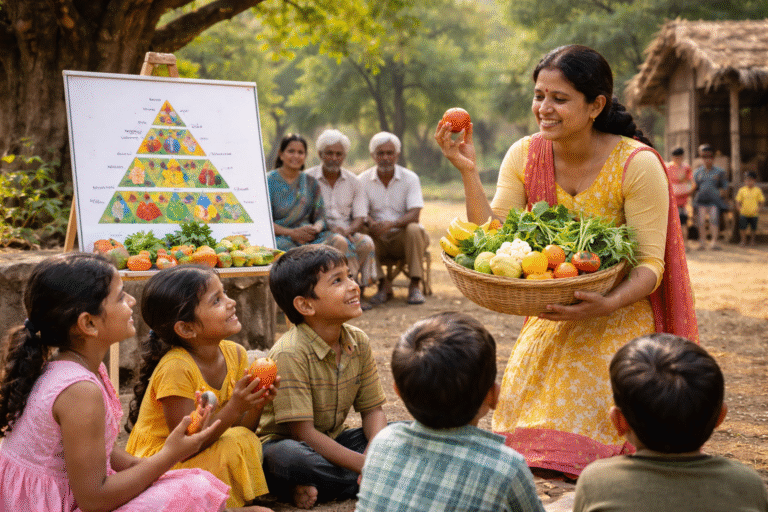
A child’s future is shaped not only by education, values, or opportunities but also by the food they eat every single day. Nutrition is the foundation on which health, energy, learning ability, emotional balance, and physical growth are built. Yet, for many children and communities across India, nutrition remains an overlooked and often misunderstood subject.
Across households, you will find children skipping meals, consuming packaged snacks, or eating food that fills the stomach but fails to nourish the body. In rural areas, lack of awareness, limited access to fresh ingredients, traditional misconceptions, and financial limitations create barriers to healthy eating. In urban areas, fast foods and sugary drinks replace home-cooked meals. Everywhere, nutrition education is missing.
But this does not have to be the reality.
Through awareness, guidance, and small changes, we can build healthier futures—one thoughtfully prepared meal at a time. When children understand the importance of food, they develop habits that stay with them for life. When families learn how to make nutritious choices, entire communities benefit. And when organisations like Flybird Foundation step forward, they help transform awareness into action.
This is the heart of nutrition awareness: empowering people with knowledge to live healthier, stronger, and more fulfilling lives.
Nutrition is not complicated—it simply means giving the body the right fuel at the right time. Food becomes energy. Food becomes strength. Food becomes immunity. Food becomes growth. For children, whose bodies are constantly developing, nutrition is even more important.
Good nutrition is not defined by expensive ingredients or exotic diets. It lies in simple, everyday foods that are affordable and accessible: grains, pulses, vegetables, fruits, milk, nuts, and clean drinking water. But many families do not know how to balance these foods or how important they are for a child’s physical and mental development.
Understanding nutrition involves learning:
When this knowledge reaches families and schools, the power to change begins.
Nutrition awareness is not just a health initiative, it is a life-building intervention. Children who eat well experience profound benefits in every aspect of their growth.
1. Better Physical Growth
Healthy bones, height development, muscle formation, and stamina all depend on nutrient-rich meals.
2. Stronger Immunity
A nourished body has the strength to fight infections, recover faster, and stay active.
3. Enhanced Concentration
Children who eat balanced meals focus better, remember better, and think more clearly.
4. Improved Academic Performance
Nutrition directly influences memory, learning speed, and cognitive strength.
5. Emotional & Behavioral Stability
Hunger causes irritability, anxiety, and low energy. Nutritious meals create emotional balance.
6. Long-term Health Protection
Healthy children become adults with reduced risk of diabetes, heart issues, and lifestyle diseases.
Nutrition awareness, therefore, is not a luxury. It is essential for shaping brighter futures.
Despite progress, India still struggles with child nutrition on multiple levels. But awareness can change this.
1. Lack of Education
Many families do not understand the nutritional value of the food they eat daily.
2. Misconceptions
Cultural beliefs sometimes lead to skipping certain foods or prioritizing quantity over quality.
3. Limited Access
In rural areas, fresh vegetables, fruits, and dairy may be seasonal or expensive.
4. Rising Junk Food Culture
Packaged foods have replaced home-cooked meals, especially among children.
5. Poor Food Diversity
Many families eat the same type of food every day, lacking nutritional balance.
6. Economic Constraints
Low-income households struggle to provide balanced meals consistently.
None of these challenges are impossible to overcome—but awareness must be the first step.
Creating a balanced plate is simpler than it seems. It includes:
Energy-Giving Foods
Rice, wheat, millets, potatoes—these provide fuel.
Body-Building Foods
Pulses, milk, eggs, peanuts, chickpeas—these build muscle and strength.
Protective Foods
Vegetables and fruits rich in vitamins and minerals keep the body healthy.
Healthy Fats
Ghee, nuts, seeds, and homemade oils support brain development.
Water
Good hydration is essential for digestion, concentration, and metabolism.
A perfect plate is not built from expensive foods, but from wise choices.
Awareness becomes meaningful when it leads to habits. Children learn through repetition, involvement, and encouragement.
Develops digestive strength and energy balance.
Gives essential vitamins and improves immunity.
Increases fiber intake and reduces illness.
Prevents excess sugar, salt, and unhealthy fat consumption.
Supports metabolism and concentration.
Improves digestion and nutrient absorption.
When these habits become a part of everyday life, children grow healthier and smarter.
Parents play the most important role in shaping a child’s eating habits. When they lead by example, children follow naturally.
1. Cooking Balanced Meals
Even on a low budget, simple combinations of grains, pulses, and seasonal vegetables can nourish a child completely.
2. Saying “No” to Junk Food
Children mirror the choices parents make.
3. Encouraging Children to Help in the Kitchen
This builds interest in healthy eating.
4. Understanding Portion Sizes
Overfeeding and underfeeding both affect growth.
5. Maintaining Clean Eating Practices
Washing hands, using clean water, and storing food safely prevent illness.
When parents are informed, their children automatically benefit.
Schools influence children for nearly half of their day. When they become partners in nutrition education, the impact multiplies.
School Activities to Promote Healthy Eating
Morning talks on nutrition
Posters made by students
Weekly “Healthy Lunch Box” days
Kitchen garden programs
Interactive games on food groups
Sessions with nutrition experts
Milk or fruit distribution drives
Teachers as Nutrition Ambassadors
Educators who speak positively about healthy eating inspire children effortlessly.
Healthy School Canteens
Providing nutritious options teaches children to choose better.
With school support, nutrition awareness reaches every child, regardless of background.
In rural communities, challenges are different but so are the strengths.
Families grow their own grains, vegetables, and pulses. Yet due to lack of awareness, the nutritional potential of these ingredients often goes unused. Many families may eat filling meals but miss out on essential vitamins and minerals simply due to lack of diversity.
Awareness programs can help by teaching:
How to prepare balanced meals using local ingredients
The value of kitchen gardens
Cost-effective protein sources like sprouts, peanuts, and lentils
Importance of washing vegetables and boiling water
How to feed infants and toddlers correctly
Nutrition education in rural areas strengthens entire communities.
Healthy eating does not need to be costly. Some of the most nutritious foods are inexpensive.
Affordable protein sources:
Sprouts, chana, peanuts, lentils, soya chunks, eggs.
Budget-friendly vegetables:
Carrots, bottle gourd, pumpkin, spinach, cabbage.
Seasonal fruits:
Bananas, guavas, apples when available, and melons.
Simple additions:
A spoon of ghee, a handful of peanuts, fresh coriander, and lemon juice.
Homemade snacks:
Roasted chana, poha, upma, idli, homemade laddoos, and vegetable paratha.
These small additions can completely transform meal quality without increasing cost significantly.
Flybird Foundation believes that no child should be limited by the food they eat. Every child deserves strength, health, and nourishment to chase their dreams confidently.
The foundation’s nutrition awareness initiatives focus on both knowledge and practicality.
Interactive sessions where children learn about food groups, balanced meals, and healthy habits.
For parents and families, covering topics like meal planning, hygiene, and affordable nutrition.
Encouraging households and schools to grow vegetables using small spaces.
Practical demonstrations showing how to prepare nutritious meals using simple, local ingredients.
Helping children understand the long-term risks of unhealthy choices.
Providing guidance and resources to families that struggle with nutrition.
With every program, Flybird Foundation aims to build stronger communities—one meal and one child at a time.
Change begins with small moments, and Flybird Foundation has witnessed several inspiring transformations.
There was a young boy who used to come to school without eating breakfast. After attending a session on energy foods, he convinced his mother to give him a small banana every morning. The teachers soon noticed a positive shift in his attention and behaviour.
A group of mothers in a rural village learned about kitchen gardens during a community workshop. Within weeks, many of them started growing spinach, tomatoes, and coriander in their own courtyards. Today, their children enjoy fresh vegetables daily.
In another school, children formed a “Healthy Tiffin Club”—inspired by a foundation session—where they remind each other to bring home-cooked meals instead of packaged snacks.
These stories show that awareness is powerful. It creates change that lasts.
Nutrition is more than food—it is an opportunity. It is growth. It is hope. When children eat well, everything improves: their health, their studies, their energy, their confidence, and their future.
By teaching nutrition awareness, we are not simply improving meals; we are improving lives. And when parents, schools, and organisations like Flybird Foundation work together, the impact becomes unstoppable.
A healthier future begins with a single, thoughtful step.
A healthier community begins with one informed family.
A healthier generation begins with one nutritious meal at a time.
Building healthier futures is not complicated. It starts with awareness, small choices, and the willingness to prioritize nourishment. Every child deserves a body that is strong, an active mind, and a life filled with opportunities—and nutrition plays a central role in unlocking all of this.
Flybird Foundation remains committed to spreading this awareness, empowering parents, guiding schools, and educating children about the importance of healthy eating. Through workshops, community involvement, and consistent efforts, the foundation strives to ensure that no child is held back due to poor nutrition.
Because one meal may seem small, but its impact can last a lifetime.
And every healthy child becomes the seed of a brighter nation.

Together, we spread hope, inspire change, and shape brighter futures.
Flybird Foundation © All Rights Reserved.