
+91 9008 41 9008
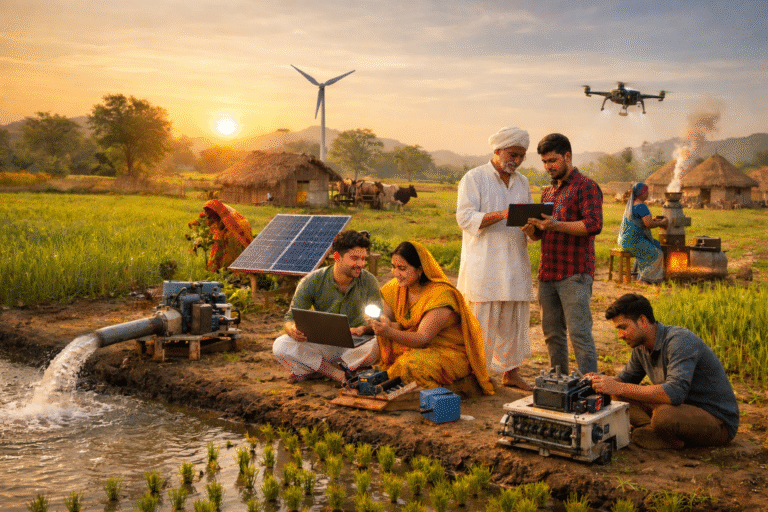
Grassroots innovation is transforming rural India in ways that go far beyond technology or tools. It is a movement built on lived experiences, local wisdom, everyday struggles, and the refusal to give up. These are not inventions born in advanced labs—they rise from farms, workshops, and village corners where people innovate out of necessity. When solutions are created by the people who face the challenges directly, they carry a rare blend of practicality and impact. Across the country, rural communities are proving that innovation does not always need big budgets; it needs purpose, passion, and a drive to uplift one another.
Today, the Flybird Foundation celebrates this spirit of ingenuity that is quietly but powerfully shaping India’s future. From sustainable agriculture to low-cost tools, from local energy solutions to community-driven ideas, grassroots innovations are rewriting narratives in villages. They show that progress does not always arrive from the top. Many times, it grows from the soil upward.
Rural India faces unique challenges—unpredictable weather, limited access to resources, lack of infrastructural support, and economic constraints. However, these challenges often ignite creativity rather than suppressing it.
Farmers create simple machines that reduce labor and save time.
Women’s groups design cost-effective tools to ease household or agricultural work.
Young students experiment with recycled materials to solve local problems.
Community members adapt traditional knowledge to modern-day needs.
These ideas are practical, affordable, and tailored for specific environments, making them immediately useful. Many of these innovations emerge simply because someone asked, “How can we make this easier?” That question becomes the spark that leads to meaningful change. The most inspiring part is that once a solution works for one family, it quickly spreads through the village, benefiting many more.
Top-down innovations often struggle in rural areas because they may be too expensive, complex, or disconnected from ground realities. On the other hand, grassroots solutions almost always succeed because they:
Use locally available materials
Require minimal maintenance
Are easy for community members to repair
Fit naturally into the cultural and social environment
Are created by people who understand the problem intimately
This makes grassroots innovations sustainable not only technically, but also socially and economically. They are built to last because they were built by the very people who rely on them. This sense of ownership ensures long-term adoption and steady growth.
Women in rural India are often the first to identify inefficiencies—whether in farming, cooking, water collection, or managing households. When they innovate, the solutions tend to improve everyday life directly.
Women-led self-help groups create low-cost machines like solar dryers, seed cleaners, or home-based craft tools.
They experiment with natural resources to produce organic dyes, soaps, or food products.
Many women entrepreneurs now introduce techniques that save time, reduce health risks, and improve income.
Their innovations have ripple effects: families become more financially stable, children receive better support, and villages develop stronger economic independence. Celebrating and nurturing this potential is essential for building a more balanced and progressive rural ecosystem.
Rural youth bring a powerful combination of fresh thinking and a deep connection to their roots. They are not afraid to try, fail, learn, and try again.
Students build prototypes from scrap materials.
Young farmers mix traditional knowledge with modern techniques.
Rural tech enthusiasts use small solar panels, motors, or recycled parts to create tools that help their communities.
What sets these young innovators apart is their ability to merge imagination with practicality. Their solutions often address issues related to mobility, education, energy access, irrigation, and environmental conservation. With proper guidance and encouragement, these young minds can redefine the future landscape of rural innovation.
Innovation at the village level often leads to better livelihoods. A small tool that improves farming efficiency can increase crop yield, reduce labor costs, and help farmers earn more. Similarly, low-cost machines for crafts, tailoring, or food processing allow families to start micro-businesses.
Some key economic impacts include:
Enhanced productivity
Reduced dependence on external markets
Better utilization of natural resources
Increased local employment
Growth of community-driven enterprises
When communities start earning more through their own innovations, economic confidence rises. This reduces migration pressure and strengthens local economies.
Many rural innovations are rooted in age-old practices. Instead of discarding them, communities adapt traditional methods with modern understanding.
Natural farming techniques become more efficient with simple tools.
Indigenous seeds gain value through seed banks and shared storage solutions.
Old construction techniques inspire eco-friendly building models.
Herbal knowledge blends with improved processing methods to create natural products.
This beautiful combination ensures that culture, heritage, and science move forward together rather than in opposite directions.
Innovation is not always an individual act. Many rural solutions emerge from conversations, shared needs, and collective experimentation.
Community groups identify problems that affect everyone.
Members brainstorm and test ideas together.
The most efficient solutions are shared widely.
Adaptations are made based on feedback and experience.
This group-driven innovation strengthens unity and builds resilience, especially in the face of climate challenges, resource scarcity, or economic fluctuations. Collective creativity ensures no one is left behind.
One of the most encouraging aspects of grassroots innovation is how quickly ideas travel. When a farmer builds a low-cost irrigation tool or a family develops a new way to process food, neighboring villages often adopt the method.
Demonstrations inspire others.
Word of mouth spreads practical techniques.
Community gatherings become platforms for sharing experiences.
Local workshops help scale the ideas further.
This organic replication ensures that even a small innovation can create a large impact across regions.
The Flybird Foundation actively supports this movement by creating platforms, providing resources, and enabling communities to experiment confidently. Our focus is on empowering rural creators so their ideas can come alive.
We strive to:
Encourage hands-on learning
Conduct awareness programs
Organize community-led innovation drives
Offer basic tools and support
Strengthen women and youth participation
Every step aims to ignite local creativity and help communities build solutions that elevate their own lives.
Many of the strongest grassroots ideas emerge directly from farms, where small improvements create major changes in productivity.
Farmers design tools using recycled materials, wooden frames, bicycle parts, or simple motors to reduce manual labor.
Low-cost weeders, seed planters, crop protectors, and moisture indicators help them work smarter, not harder.
These innovations often cut production costs, reduce dependency on expensive machinery, and make farming more efficient for small landholders.
The beauty lies in their adaptability — one tool made in a single village often gets replicated in dozens of surrounding communities.
Rural entrepreneurs frequently build ideas around local needs: water scarcity, transport difficulties, storage limitations, or seasonal income gaps.
They create products that are affordable for villages — from low-cost solar lanterns to bamboo-based household utilities.
Many use waste materials creatively, transforming discarded items into useful, long-lasting resources.
These small ventures not only solve problems but become sources of income, helping families become more financially independent.
As entrepreneurs grow, they inspire others, creating a chain of innovation-driven economic upliftment.
Innovation in rural education is one of the most transformative aspects of grassroots creativity.
Teachers and youth volunteers develop simple digital setups using old smartphones, miniature projectors, solar chargers, and low-cost screens.
Learning corners are created in community halls or under shaded trees, turning education into a community activity rather than a school-only process.
Students benefit from visual learning, interactive tools, and improved engagement — all created without waiting for external funding.
These education innovations ensure that even remote villages can access modern learning experiences.
Grassroots innovations often focus on improving daily life in small but meaningful ways, such as safer stoves, water filters, low-cost transport aids, or multipurpose household tools.
Villages adapt eco-friendly methods like homemade composters, natural cooling systems, or clay-based storage solutions to reduce environmental impact.
These solutions promote cleaner living, better health, and lower expenses for families.
What begins as an idea in a single home often becomes a community-wide practice.
Over time, these sustainable habits strengthen resilience and create a greener rural ecosystem.
Grassroots innovation is the heartbeat of rural India’s progress. It is built on intuition, experience, and a desire for a better tomorrow. These ideas, crafted from everyday challenges, have the power to uplift families, empower communities, and reshape the development story of the nation. When rural minds are encouraged and supported, innovation becomes unstoppable.
The Flybird Foundation believes that rural India does not just need external support it needs recognition, encouragement, and platforms to share its brilliance. By nurturing this spirit, we move closer to a future where every village becomes a center of creativity, resilience, and hope.

Together, we spread hope, inspire change, and shape brighter futures.
Flybird Foundation © All Rights Reserved.